

Better decisionsstart with context.
PairScore is a context-aware compatibility and decision-support platform, built to evaluate relationships beyond a single score, rank or threshold.
Our first applicant-facing model helps future physicians see how their academic profile, experiences, goals, preferences and environment align across medical schools.
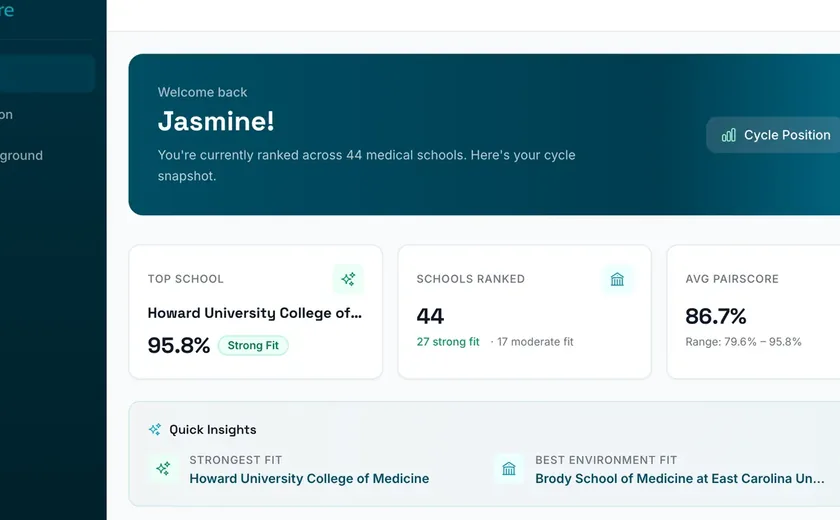
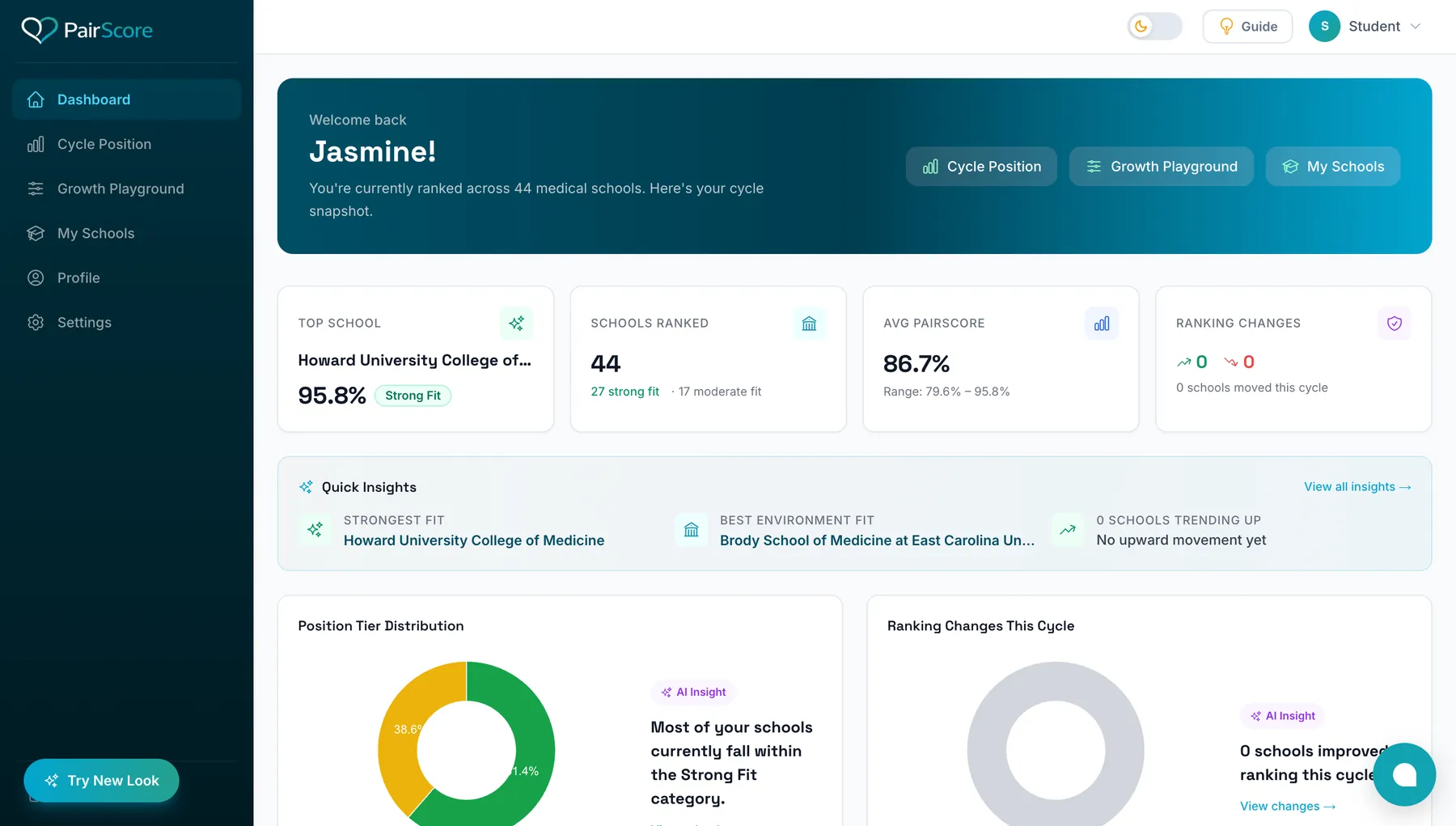
Real product interface, captured from a test account. The schools and scores it shows belong to a sample profile and are not a rating of any institution.
One framework.Multiple applications.
PairScore brings quantitative, contextual, experiential, preference and relationship-based information together to evaluate compatibility across multiple dimensions. Different PairScore models adapt that framework to different decisions and users.
A list is easy.Knowing why is not.
A ranked list of medical schools takes ten seconds to find, and every applicant in the country is looking at the same one. What it cannot tell you is whether the hours you spent in a free clinic, the research you did, or the fact that you intend to practice in the county you grew up in mean anything to the school sitting at number four.
So the real list gets built somewhere else: in a spreadsheet, out of forum threads and admissions averages, with one column nobody can fill in.
school-list-final.xlsx
| School | Avg MCAT | Avg GPA | Fit |
|---|---|---|---|
| Cedar Ridge | 515 | 3.74 | ? |
| Northbank | 517 | 3.81 | ? |
| Harbor Point | 513 | 3.69 | ? |
| Riverbend | 519 | 3.88 | ? |
Illustrative example. Sample data, not real institutions.
Two solutions.One platform.
Your list, sorted by fit.Not by prestige.
Personalized rankings and Position Tiers
One 0–100 PairScore per school, built from independently calculated dimensions and shown with the factors that produced it. The Position Tier turns that into Strong Fit, Moderate Fit or Low Fit. It describes the strength of your relationship with that one school, not your rank against other applicants.
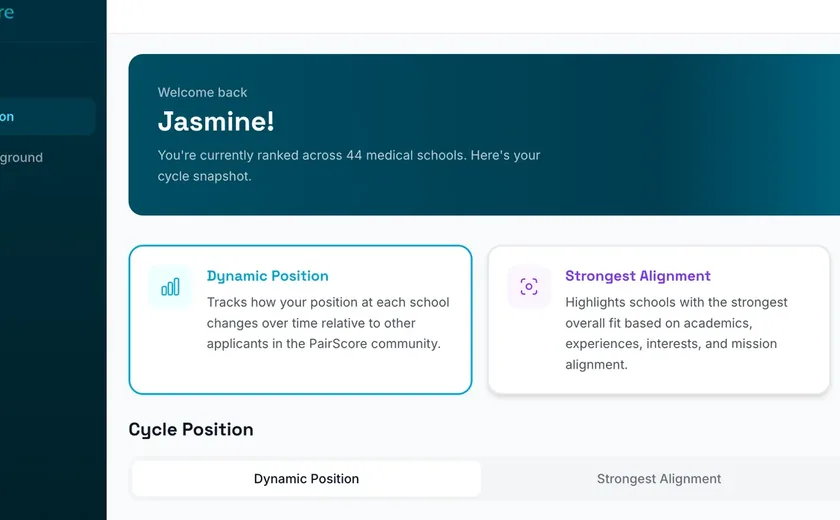
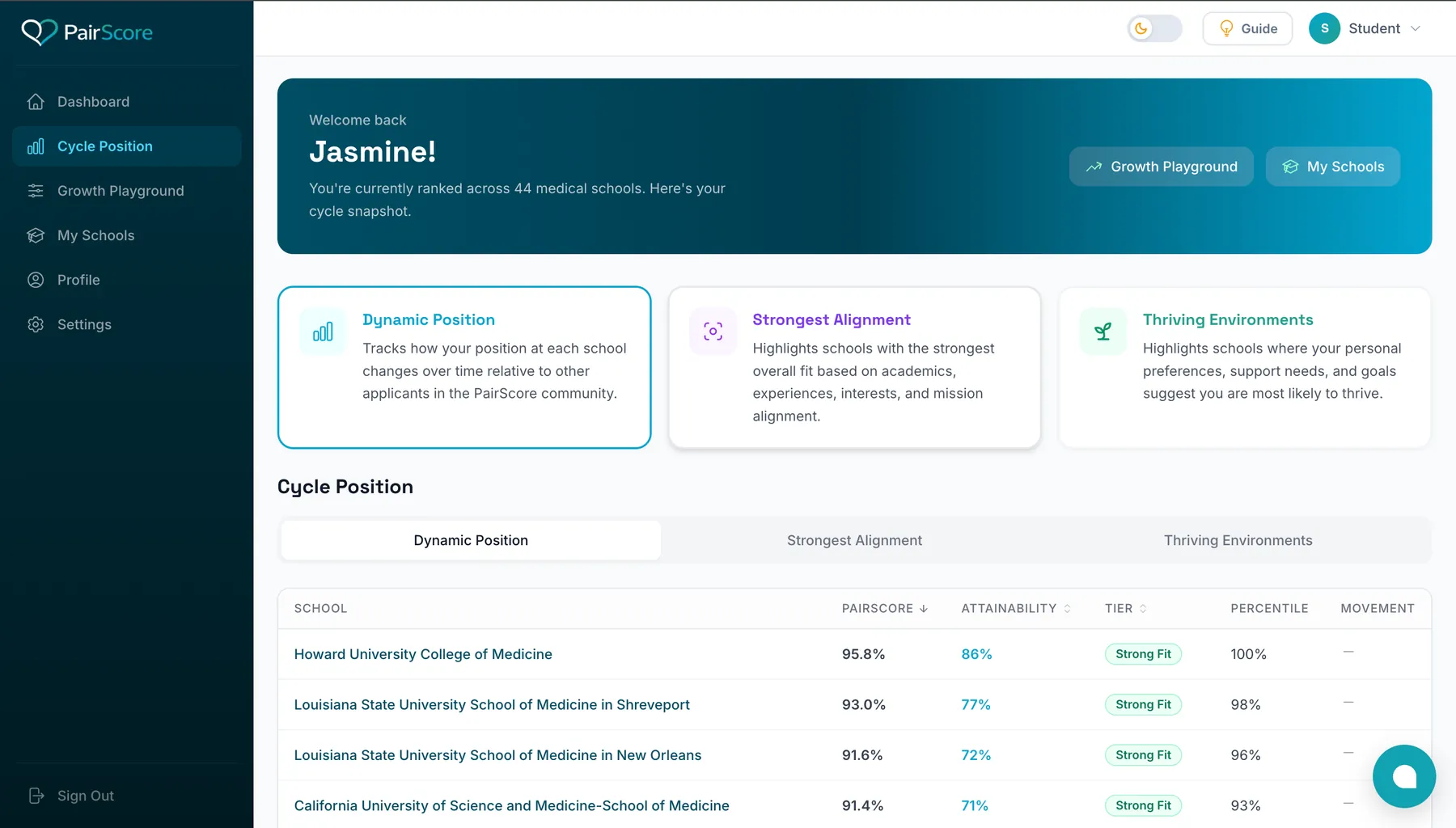
Illustrative example. Sample data, not real institutions or real results.
Move one number.The list moves.
Growth Playground
Model a change you are actually weighing. Three more MCAT points, another semester of research, a service commitment you have not made yet. The list re-scores against it, and Cycle Movement shows which schools moved and by how many positions. Free accounts include two scenarios.
Growth Playground
- 1Cedar Ridge College of Medicine91Strong Fit
- 2Northbank University School of Medicine88Strong Fit
- 3Harbor Point University School of Medicine86Strong Fit
- 4Riverbend University School of Medicine79Moderate Fit
- 5Lakeview State School of Medicine74Moderate Fit
- 6Granite Valley College of Osteopathic Medicine68Low Fit
Showing the list scored against the current profile.
Illustrative example. Sample data, not real institutions or real results. Switch the scenario to re-sort the list.
Scores summarize.Reasoning explains.
School Alignment Insights
Every school arrives with a written explanation of why it does or does not align with you right now: which of your experiences the model read, which part of the school's stated mission it matched them to, and what it could not find. You are free to disagree with it. You are not left guessing.
Riverbend University School of Medicine
School Alignment Insights
- Mission Alignment
- 88
- Academic Fit
- 74
- Thriving Score
- 81
Where you align
- Riverbend's mission names primary care for rural and medically underserved communities in its own state.
- Your mobile clinic hours and your stated intent to practice in the county you grew up in map onto that directly.
Where you do not, yet
- Riverbend weights sustained longitudinal involvement. Your clinical hours are spread across four short placements rather than one long one.
- Nothing in your profile speaks to their rural immersion track, which their own materials treat as central.
Illustrative example. Sample data, not real institutions or real results.
Stop pairing by hand.Pair by theme.
Mentorship matching, applied with To Be An M.D.
A Match Run puts stable matching over your whole participant pool at once: shared experience themes and growth opportunities, mutual requests given priority, and an AI-enriched shortlist pass over the strongest candidates. You approve the pairings. The run does the work of finding them.
Match Run · Sample cohort
Completed
- Total pairs
- 34
- Capacity Utilization
- 82%
- Avg match score
- 78
- Unmatched
- 3
- MEN-118MTE-042matched to each other. Mutual request.Mutual request92
- MEN-104MTE-017matched to each other. Shared theme: rural health.Shared theme: rural health88
- MEN-131MTE-055matched to each other. Shared theme: translational research.Shared theme: translational research84
- MEN-127MTE-009matched to each other. Capacity 2 of 3 used.Capacity 2 of 3 used71
Illustrative example. Sample run, not a real cohort.
How PairScore works.Four steps, in order.
- 01
Build your profile
Academics, experiences, and the AMCAS-style narratives you have already written for your application. PairScore reads the writing, not only the numbers.
- 02
The narratives get interpreted
Your written experiences are turned into structured alignment signals. The interpretation is gated on narrative completeness, so a thin profile is told it is thin rather than quietly scored as if it were not.
- 03
Your list is scored and tiered
Every school gets a PairScore, a Position Tier, a Thriving Score and an Academic Fit and Mission Alignment breakdown, with a written explanation of each.
- 04
Change something, run it again
Growth Playground re-scores the whole list against a change you are considering and shows you the Cycle Movement: exactly which schools moved, and by how many positions.
Your list gets built.This one explains.
Create an account, add the schools you are weighing, and read the reasoning behind every position on the list.